
Why the Launch Matters
The first year of The Global Risks Alliance will define its institutional character.
It will determine whether GRA is understood as another association brand, another conference concept, another policy forum, another sponsor-driven network, or something more serious: a next-generation industry association and business league for financial services risk readiness in an age of systemic risk, exponential technology, and complex connected hazards.
The first year must therefore be designed with discipline.
GRA should not launch as a vague movement.
It should launch as a structured institution with a clear thesis, clear boundaries, clear membership pathways, clear sector platforms, clear council roles, clear working group mechanisms, clear sponsor controls, clear public authority engagement rules, clear public-safe reporting standards, and a visible annual destination through Nexus Universe.
The first year should prove that GRA can organize serious people around serious work.
It should show that financial services needs a governed platform for all-hazards and whole-of-society risk readiness.
It should show that insurers, banks, asset managers, institutional funds, sovereign wealth funds, development finance institutions, public finance actors, capital markets leaders, fintech firms, infrastructure investors, private equity, family offices, enterprise risk leaders, regulators, public authorities, universities, civil society organizations, technical experts, sponsors, and emerging leaders can work together without confusing their roles.
The first year should create trust before scale.
The First-Year Objective
The first-year objective is not to do everything.
The objective is to build the operating foundation for GRA.
That means establishing:
the public identity;
the founding article package;
the membership pathway;
the digital community;
the initial councils;
the priority sector platforms;
the first working groups;
the first protocol drafts;
the first public-safe reports;
the sponsor and partner framework;
the public authority engagement framework;
the recognition system;
the Nexus Universe preparation model;
and the first annual launch cycle.
The goal is to move from concept to credible operating institution.
A successful first year should leave GRA with members, records, outputs, protocols, reports, sponsors, partners, and a clear pipeline into Nexus Universe.
The Founding Thesis
The founding thesis of GRA should be stated clearly everywhere:
financial services is entering an era in which risk is no longer sector-by-sector, hazard-by-hazard, or institution-by-institution.
Climate, catastrophe, cyber, AI, infrastructure, public finance, nature, critical systems, geopolitical volatility, digital concentration, insurance protection gaps, and exponential technology are becoming connected risk systems.
Financial services needs a new association model to understand and respond to this environment.
GRA exists to provide that model.
It is an industry association and business league for financial services risk readiness.
It operates through all-hazards and whole-of-society principles.
It connects to the Nexus Ecosystem and uses Nexus Universe as its annual testing and reporting program.
It supports protocols, public-safe finance reports, sector platforms, councils, working groups, protocol labs, member education, and recognition records.
It does not provide investment advice, underwriting, brokerage, project finance, securities promotion, ratings, certification, procurement approval, regulatory approval, fiduciary advice, transaction execution, endorsement, or guarantees of bankability, insurability, or investability.
This thesis should guide the entire launch.
Launch Principle One: Clarity Before Complexity
The first year should prioritize clarity before complexity.
GRA has a large architecture, but new members and public audiences need a clear path.
They should understand:
what GRA is;
why it exists;
who it serves;
what problems it addresses;
how it operates;
how members participate;
what Nexus Universe is;
what GRA does not do;
and why it matters now.
Avoid launching with every internal framework at once.
Start with the public-facing foundation.
Then introduce platforms, councils, working groups, protocols, reports, and Nexus Universe in a structured sequence.
A complex architecture can still be communicated simply.
Launch Principle Two: Boundaries Build Trust
GRA’s boundaries are not legal afterthoughts.
They are central to trust.
From day one, GRA should be clear that it does not provide investment advice, securities recommendations, underwriting, brokerage, project finance, credit ratings, fiduciary advice, legal advice, tax advice, accounting advice, actuarial advice, regulatory approval, procurement approval, public policy, technology certification, project validation, ESG validation, climate certification, biodiversity certification, or transaction execution.
This clarity makes GRA safer for serious institutions.
Banks can participate without fearing informal investment advice.
Insurers can participate without implying underwriting.
Public authorities can participate without being misused as approval.
Sponsors can support without controlling.
Technical providers can demonstrate without claiming certification.
Members can contribute without overclaim.
Boundaries make participation possible.
Launch Principle Three: Contribution Over Prestige
GRA should not build its first year around title inflation.
It should build around contribution.
Councils should exist to guide work.
Working groups should produce outputs.
Sponsors should support public-good readiness.
Students should contribute to real records.
Public-good partners should shape safeguards and whole-of-society perspective.
Technical experts should help test and document methods.
Recognition should follow verified contribution.
The first year should avoid creating a large list of honorary roles that do not produce work.
A smaller group of active contributors will create more trust than a larger passive network.
Launch Principle Four: Public-Safe Outputs First
GRA should produce visible outputs early.
The first public package should explain GRA’s identity, mission, sector platforms, operating model, membership, public authority engagement, sponsor rules, capital-room firewalls, public-safe reporting, recognition, digital community, annual cycle, and Nexus Universe.
This 50-article founding package should serve as the first SEO foundation and institutional knowledge base.
After that, GRA should produce shorter public-safe briefs and member-oriented guides.
The first year should not wait for perfection before publishing.
It should publish clear, bounded, professional outputs and improve them through correction and versioning.
Launch Principle Five: Nexus Universe as the Annual Destination
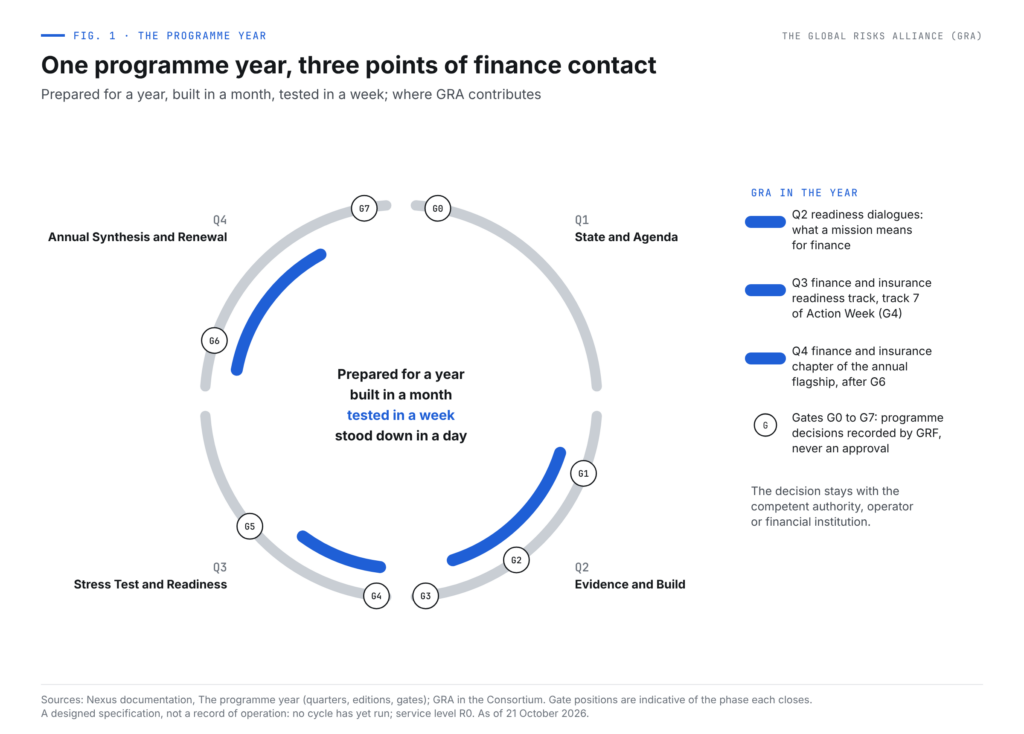
From the beginning, GRA should position Nexus Universe as the annual program where year-round readiness work is tested, reported, and recognized.
Nexus Universe should not be introduced as a generic event.
It should be introduced as the annual convergence environment for GRA’s councils, platforms, working groups, protocol labs, technical demonstrations, public-safe reports, recognition records, and Nexus Ecosystem integration.
Members should know that joining GRA means participating in a year-round cycle that leads toward Nexus Universe.
Sponsors should know they are supporting a disciplined annual program, not buying stage visibility.
Public authorities should know their roles will be recorded accurately.
Students should know Nexus Universe creates contribution pathways.
Nexus Universe gives the first year a clear destination.
Phase One: Publish the Founding Package
The first launch phase should publish the complete founding article package.
This package should explain GRA in full.
It should include articles on:
GRA identity and mission;
all-hazards and whole-of-society risk;
Nexus Ecosystem integration;
the industry association and business league role;
financial services sector platforms;
insurance and reinsurance;
banking;
asset management;
institutional funds;
sovereign wealth and public funds;
capital markets;
development finance;
public finance;
fintech;
infrastructure finance;
private equity and real assets;
family offices;
enterprise risk;
financial regulation and supervisory engagement;
exponential technology and AI;
cyber financial continuity;
climate and catastrophe risk;
nature-related financial risk;
critical systems finance;
public authority engagement;
sponsor and partner framework;
capital-room firewalls;
public-safe finance reporting;
membership;
operating model;
knowledge products;
recognition;
digital community;
annual cycle;
and first-year roadmap.
This package becomes the foundation for trust, SEO, onboarding, internal alignment, and outreach.
Phase Two: Build the Core Website Structure
After the founding package is ready, GRA should structure the website around clear institutional pathways.
The website should include:
homepage;
about GRA;
mission and thesis;
what GRA does;
what GRA does not do;
sector platforms;
membership;
sponsors and partners;
public authority engagement;
knowledge products;
Nexus Universe;
digital community;
recognition;
contact and join pathway.
Each sector platform should have its own page.
Each page should include purpose, audience, workstreams, Nexus Universe connection, public-safe reporting, and boundaries.
The website should make GRA look like a serious institution from day one.
Phase Three: Launch the Digital Community
The digital community should launch early, but in phases.
Start with:
orientation;
community rules;
announcements;
first general forum;
membership onboarding;
sector platform previews;
working group interest forms;
sponsor information;
student and emerging professional pathway;
public-safe reporting guidance;
and recognition guidance.
The first forum should be a professional starting point for introductions, onboarding questions, test posts, early updates, and generated discussion topics.
As the community matures, add sector platform groups, working group rooms, protocol libraries, Nexus Universe hubs, sponsor records, public authority records, knowledge product library, and recognition hub.
The first goal is not complexity.
The first goal is controlled participation.
Phase Four: Activate Founding Platforms
GRA should not activate every platform equally in the first month.
It should activate priority platforms first.
The first-year priority platforms should likely include:
Insurance and Reinsurance;
Banking;
Asset Management and Institutional Funds;
Capital Markets;
FinTech and Digital Financial Infrastructure;
Development Finance and Public Finance;
Infrastructure Finance;
Cyber Risk and Financial Continuity;
Exponential Technology and AI Risk;
Climate, Catastrophe, and Protection Gaps;
Biodiversity and Nature-Related Financial Risk;
Critical Systems Finance;
Financial Regulation and Supervisory Engagement;
Enterprise Risk and Corporate Finance.
Other platforms can be activated as membership grows.
Each platform should launch with a clear description, lead needs, first working group ideas, and Nexus Universe relevance.
Phase Five: Recruit Founding Members
The first member recruitment campaign should focus on credibility and contribution.
Target audiences should include:
insurance and reinsurance leaders;
banking risk and resilience leaders;
asset management and institutional fund leaders;
sovereign wealth and public fund professionals;
development finance and public finance experts;
capital markets and market infrastructure professionals;
fintech and digital identity leaders;
infrastructure investors and operators;
cybersecurity and AI governance experts;
climate, catastrophe, and nature-risk specialists;
enterprise risk leaders;
universities and research centers;
civil society and public-good partners;
students and emerging professionals;
and mission-aligned sponsors.
The recruitment message should not be generic.
It should say: join GRA to help build the next generation of financial services risk readiness.
Phase Six: Form the Initial Councils
GRA should form initial councils around priority areas.
The first councils may include:
Insurance and Risk Transfer Council;
Banking and Financial Continuity Council;
Capital and Markets Council;
Institutional Funds and Sovereign Capital Council;
Development and Public Finance Council;
FinTech and Digital Infrastructure Council;
AI and Exponential Technology Council;
Cyber Financial Continuity Council;
Climate, Catastrophe, and Protection Gap Council;
Nature and Critical Systems Council;
Public Authority and Supervisory Engagement Council;
Knowledge, Standards, and Reporting Council;
Membership, Recognition, and Community Council;
Sponsor and Partner Governance Council.
Each council should have a founding mandate, annual cycle role, working group connection, and public-safe boundaries.
Council roles should be contribution-based.
Phase Seven: Launch First Working Groups
The first working groups should be practical and output-driven.
Recommended first working groups include:
GRA Public-Safe Finance Reporting Working Group;
GRA Capital-Room Firewalls Working Group;
GRA Insurance-Readiness and Protection Gap Working Group;
GRA Cyber Financial Continuity Working Group;
GRA AI Governance and Agentic AI Controls Working Group;
GRA Climate Adaptation Finance-Readiness Working Group;
GRA Infrastructure Insurability Working Group;
GRA Public Finance Exposure Working Group;
GRA Digital Identity and Fraud Working Group;
GRA Nature-Related Financial Risk Working Group;
GRA Nexus Universe Track Planning Working Group;
GRA Recognition and Contribution Records Working Group.
These groups should produce the first practical outputs.
Phase Eight: Draft the First Protocols
The first protocols should support GRA’s own operating integrity and member value.
Priority protocols should include:
Public-Safe Finance Reporting Protocol;
Capital-Room Firewall Protocol;
Sponsor and Partner Disclosure Protocol;
Public Authority Engagement Record Protocol;
Recognition and Badge Record Protocol;
Technical Demonstration Record Protocol;
Protocol Lab Design Protocol;
Insurance-Readiness Brief Protocol;
Capital-Readiness Note Protocol;
Cyber Financial Continuity Exercise Protocol;
AI Governance Readiness Protocol;
Nexus Universe Track Reporting Protocol.
These protocols will help GRA scale safely.
They should be drafts at first, then tested through working groups and protocol labs.
Phase Nine: Prepare First Public-Safe Briefs
After working groups begin, GRA should publish shorter public-safe briefs.
These may include:
Why Financial Services Needs an All-Hazards Risk Association;
What Insurance-Readiness Means and Does Not Mean;
Cyber Financial Continuity: A Readiness Brief for Financial Services;
AI Governance in Financial Services: Readiness Questions for Boards and Risk Leaders;
Protection Gaps as Public Finance and Insurance Risk;
Capital Readability Without Capital Raising;
Public Authority Participation Without Approval Overclaim;
Nexus Universe: The Annual Testing Program for GRA;
How Members Contribute to GRA Working Groups;
How Sponsors Support GRA Without Buying Authority.
These briefs can drive SEO, outreach, and member education.
Phase Ten: Build the Sponsor Pipeline
Sponsors should be recruited carefully.
Potential sponsors may include banks, insurers, reinsurers, asset managers, technology firms, cloud providers, cyber companies, consulting firms, law firms, universities, foundations, data providers, infrastructure firms, payment providers, and public-good institutions.
Sponsor packages should emphasize mission support, not access.
Offer sponsorship of:
public-safe reports;
student pathways;
civil society participation;
accessibility and translation;
protocol labs;
technical environments;
Nexus Universe tracks;
digital community infrastructure;
knowledge products;
and annual operations.
Do not sell council seats.
Do not sell public authority access.
Do not sell report conclusions.
Do not sell certification.
Trust must be the sponsor product.
Phase Eleven: Engage Public Authorities Carefully
Public authority engagement should begin with orientation and role clarity.
GRA should invite regulators, supervisors, central banks, ministries, cities, public agencies, public finance institutions, development finance institutions, sovereign institutions, and multilateral organizations to participate where appropriate.
Initial roles should often be observer, speaker, or context contributor.
GRA should provide public authority role language in advance.
Every engagement should be recorded.
No public authority should be used in marketing as approval.
Public authorities should experience GRA as a safe and serious platform.
That will create long-term trust.
Phase Twelve: Design the First Nexus Universe Tracks
GRA should prepare first-year Nexus Universe tracks early.
Possible first tracks include:
Insurance Protection Gaps and Climate Catastrophe Readiness;
Cyber Financial Continuity and Payment Resilience;
AI Governance, Agentic AI, and Financial Services Control;
Infrastructure Insurability and Climate Adaptation Finance-Readiness;
Public Finance, Municipal Risk, and Disaster Risk Finance;
FinTech, Digital Identity, Fraud, and Payments;
Capital Markets Disclosure-Readiness and Information Integrity;
Development Finance, Country Readiness, and Safeguards;
Nature-Related Financial Risk, Water, Food, and Ecosystem Services;
Institutional Funds, Sovereign Wealth, and Long-Horizon Systemic Risk;
Critical Systems Finance: Health, Food, Water, Energy, and Infrastructure.
Each track should have a working group basis, protocol question, reporting plan, and recognition pathway.
Phase Thirteen: Run Initial Protocol Labs
Before or during Nexus Universe, GRA should run a small number of first protocol labs.
Do not run too many.
Choose labs that demonstrate the model.
Possible first labs include:
Cyber Financial Continuity Lab: payment disruption and cloud dependency;
AI Governance Lab: agentic AI workflow controls in financial services;
Insurance-Readiness Lab: climate catastrophe protection gap scenario;
Infrastructure Insurability Lab: flood resilience and risk allocation;
Public Finance Exposure Lab: municipal climate shock and fiscal resilience;
Digital Identity and Fraud Lab: deepfake authorization and synthetic identity;
Technical Demonstration Record Lab: documenting a dashboard, digital twin, or AI tool safely.
Each lab should produce a report with findings and limitations.
Phase Fourteen: Issue First Recognition Records
After the first working groups, reports, labs, and Nexus Universe tracks, GRA should issue recognition records.
Recognition should cover:
founding council service;
platform leadership;
working group contribution;
protocol drafting;
protocol lab participation;
public-safe reporting contribution;
technical demonstration support;
student contribution;
civil society contribution;
host support;
sponsor support;
Nexus Universe track preparation;
and public-good contribution.
Recognition should be shareable on LinkedIn, but claim-safe.
Every recognition should state what it does not imply.
This will create professional value and participation incentives.
Phase Fifteen: Publish the First Annual Report
At the end of the first annual cycle, GRA should publish its first annual report.
The report should summarize:
the founding thesis;
membership growth;
platforms activated;
councils formed;
working groups launched;
protocols drafted;
protocol labs conducted;
public-safe briefs published;
Nexus Universe tracks prepared or delivered;
public authority engagement;
sponsor and partner support;
student and civil society participation;
recognition issued;
corrections made;
and next-year priorities.
This annual report should be public-safe, polished, and boundary-controlled.
It should be GRA’s first institutional accountability record.
First-Year Minimum Viable Operating System
By the end of year one, GRA should have a minimum viable operating system.
This should include:
a public website;
a founding article package;
membership onboarding;
a digital community;
at least five active sector platforms;
at least three active councils;
at least five working groups;
at least three protocol drafts;
at least two protocol labs;
at least three public-safe briefs;
a sponsor framework;
a public authority engagement framework;
a recognition system;
a Nexus Universe track plan;
and a first annual report.
This is enough to prove the model.
Scale can come after operating credibility.
First-Year Priority Roles
GRA will need core roles to execute the launch.
Priority roles include:
Executive Lead;
Membership Lead;
Platform Development Lead;
Council Coordination Lead;
Working Group Program Lead;
Public-Safe Reporting Lead;
Sponsor and Partner Lead;
Public Authority Engagement Lead;
Digital Community Lead;
Nexus Universe Program Lead;
Technical Demonstration Lead;
Recognition and Records Lead;
Student and Emerging Leaders Lead;
Civil Society and Public-Good Engagement Lead;
Communications and SEO Lead;
Governance and Claims Control Lead.
These roles may begin as volunteer or part-time roles, but the responsibilities should be professional.
First-Year Communications Strategy
GRA’s communications should be mature, expert, and consistent.
The message should be:
GRA is the next-generation association for financial services risk readiness.
GRA addresses systemic risk through all-hazards and whole-of-society principles.
GRA connects financial services to the Nexus Ecosystem.
GRA uses Nexus Universe as an annual readiness and testing program.
GRA produces protocols, public-safe reports, working groups, and recognition records.
GRA welcomes members, sponsors, public-good partners, experts, and public authorities where appropriate.
GRA does not provide investment advice, underwriting, certification, regulatory approval, procurement approval, or transaction execution.
Every communication should reinforce this identity.
First-Year SEO Strategy
The first-year SEO strategy should use the founding package as the content backbone.
Target keywords should include:
financial services risk management;
systemic risk in financial services;
all-hazards risk management;
financial services association;
insurance protection gaps;
insurance-readiness;
cyber financial continuity;
AI governance in financial services;
climate risk finance;
catastrophe risk finance;
public finance resilience;
development finance readiness;
infrastructure finance-readiness;
capital readiness;
public-safe finance reporting;
nature-related financial risk;
critical systems finance;
fintech risk governance;
digital identity financial services;
Nexus Universe;
and Global Risks Alliance.
SEO should never become exaggerated marketing.
It should make serious content findable.
First-Year Outreach Strategy
The first-year outreach strategy should be segmented.
For insurers: emphasize protection gaps, catastrophe risk, cyber accumulation, AI, and insurance-readiness.
For banks: emphasize operational resilience, credit exposure, payments, cyber, AI, and climate risk.
For asset managers and funds: emphasize long-horizon systemic risk, stewardship, disclosure-readiness, nature risk, infrastructure, and public-safe reporting.
For sovereign and public funds: emphasize public capital readiness, fiscal exposure, intergenerational resilience, infrastructure, climate, and cyber.
For fintechs: emphasize responsible innovation, identity, payments, fraud, AI, and cyber resilience.
For development finance: emphasize country readiness, safeguards, adaptation, disaster risk finance, and public-good capital.
For public authorities: emphasize safe dialogue, role clarity, and public-safe reporting.
For universities: emphasize research translation, student pathways, and protocol labs.
For sponsors: emphasize public-good readiness support without authority purchase.
First-Year Risk Register
GRA should maintain a first-year risk register.
Key risks include:
unclear public identity;
too much complexity too early;
weak boundaries;
sponsor overclaim;
public authority misrepresentation;
insufficient outputs;
too many councils without work;
volunteer burnout;
digital community noise;
underdeveloped reporting standards;
technical demonstration hype;
recognition inflation;
capital-room leakage;
insurance-readiness overclaim;
public-safe reports that sound promotional;
and lack of correction procedures.
Each risk should have a mitigation plan.
A serious institution manages its own launch risks.
First-Year Governance Priorities
Governance priorities should include:
membership terms;
community rules;
sponsor terms;
public authority role terms;
working group mandates;
reporting standards;
recognition criteria;
capital-room firewalls;
insurance-readiness firewalls;
antitrust reminders;
confidentiality rules;
technical demonstration standards;
correction process;
and archive policy.
Governance should be practical.
It should enable work while preventing misuse.
First-Year Budget Priorities
Even if GRA begins lean, it should know what budget categories matter.
Priority categories include:
website and content;
digital community platform;
membership systems;
legal and governance support;
communications and design;
program coordination;
public-safe reporting production;
technical infrastructure;
event and Nexus Universe planning;
student participation;
civil society participation;
translation and accessibility;
sponsor management;
public authority engagement support;
records and recognition systems;
and administrative operations.
Budget should follow mission priorities.
First-Year Success Metrics
GRA should define success metrics early.
Possible first-year metrics include:
founding package published;
website launched;
digital community launched;
members onboarded;
sector platforms activated;
councils formed;
working groups launched;
protocol drafts completed;
public-safe briefs published;
sponsors secured;
public-good partners engaged;
students onboarded;
public authority engagements recorded;
protocol labs completed;
Nexus Universe tracks designed;
recognition records issued;
annual report published;
and corrections handled.
Quality should matter more than raw volume.
What GRA Should Avoid in Year One
GRA should avoid:
claiming global authority too early;
launching too many platforms without leads;
selling sponsorship as access;
allowing product promotion;
using public authority names loosely;
creating badges that look like certifications;
calling drafts final;
running events without outputs;
publishing reports without boundary language;
promoting Nexus Universe as a conference only;
creating investment or insurance signals;
overpromising member benefits;
and ignoring correction needs.
The first year should be ambitious but disciplined.
The First-Year Public Promise
GRA’s first-year public promise should be simple:
GRA will build the operating community financial services needs to understand systemic risk, test readiness methods, produce public-safe knowledge, and prepare for Nexus Universe.
It will do this with clear boundaries.
It will welcome members and partners.
It will produce outputs.
It will record contributions.
It will correct overclaim.
It will connect finance to public-good risk readiness.
It will not pretend to be something it is not.
This promise is powerful because it is credible.
Why the First Year Can Define the Category
If executed well, GRA can define a new category.
It can become the association model financial services needs for an era where risk is systemic, technological, physical, public, and interconnected.
Traditional associations often focus on advocacy, networking, member services, policy, training, or events.
GRA can integrate those functions into a broader readiness architecture: councils, platforms, protocols, protocol labs, public-safe reports, Nexus Universe, Nexus Ecosystem integration, recognition records, digital community, and public authority boundaries.
This is more than an association.
It is a risk readiness operating layer for financial services.
The first year is where that category becomes visible.
A Call to Launch GRA With Discipline and Ambition
GRA invites founding members, financial institutions, insurers, reinsurers, banks, asset managers, institutional funds, sovereign wealth funds, development finance institutions, public finance institutions, capital markets actors, fintech firms, infrastructure investors, private equity firms, family offices, enterprise leaders, regulators and public authorities where appropriate, universities, civil society organizations, technical experts, sponsors, students, and Nexus Ecosystem partners to help build the first year.
Read the founding package.
Join the membership pathway.
Enter the digital community.
Choose your platform.
Serve through a council.
Contribute to a working group.
Draft a protocol.
Support a protocol lab.
Prepare Nexus Universe.
Sponsor public-good participation.
Engage public authorities responsibly.
Create public-safe reports.
Record contribution.
Correct overclaim.
Build the institution before demanding the spotlight.
The first year of GRA should be remembered as the year financial services began building the association it needed for the age of systemic risk.
That is the roadmap.
From founding package to membership.
From membership to platforms.
From platforms to councils.
From councils to working groups.
From working groups to protocols.
From protocols to labs.
From labs to Nexus Universe.
From Nexus Universe to public-safe reports.
From reports to recognition.
From recognition to the next cycle.
That is how GRA launches with credibility, scale, and purpose.