

How a year of preparation becomes a week of controlled testing in Nexus Universe, and how the finance and insurance readiness track reads its results. It also explains what recognition means when nothing is credentialed without an accountable issuer.
Key takeaways
- The finance and insurance readiness track is a planned track of the Nexus Universe exercise week, which The Global Risks Forum (GRF) governs; The Global Risks Alliance (GRA) is designed to run it, and The Global Centre for Risk and Innovation (GCRI) supplies the evidence it reads [1, 2].
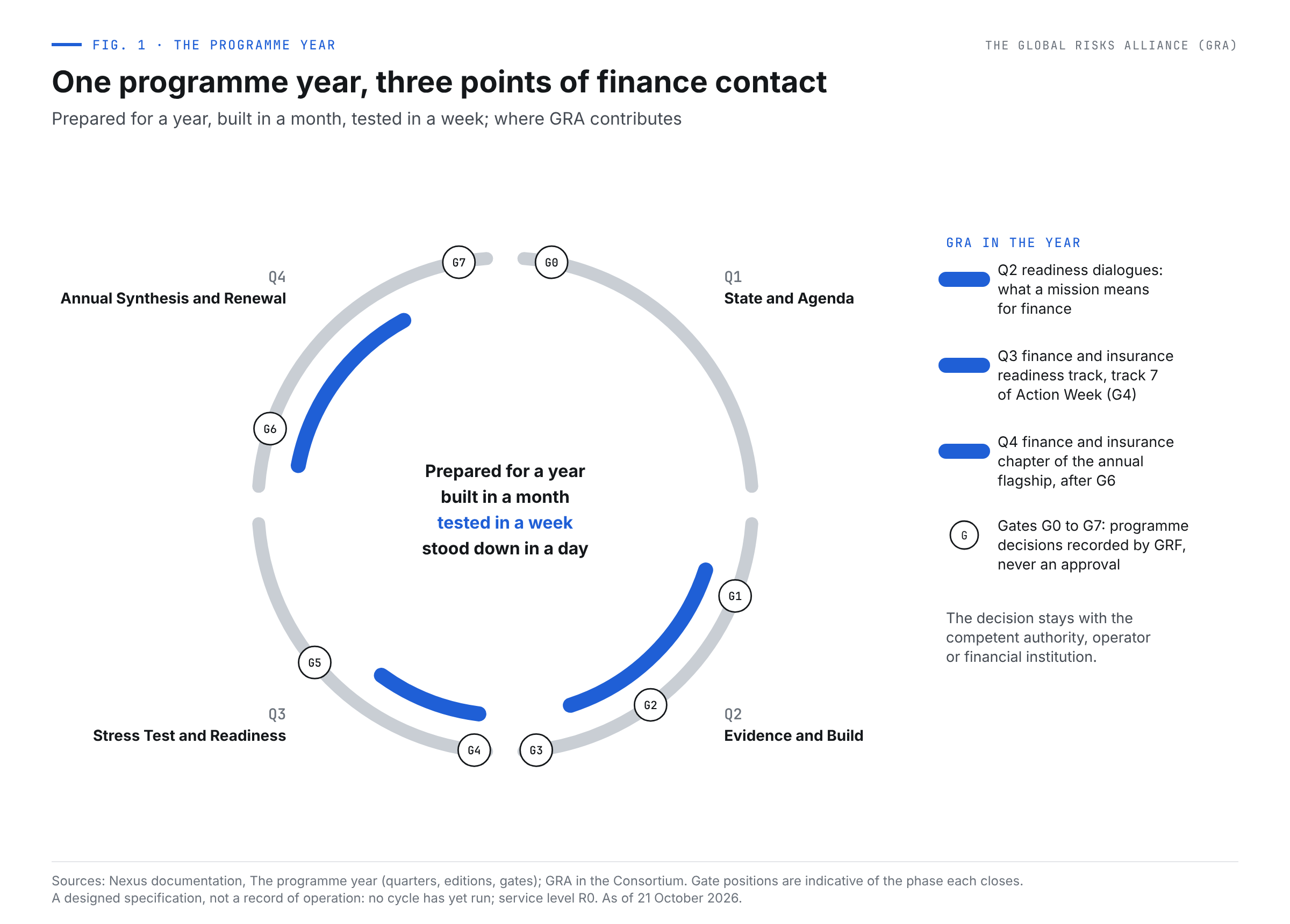
- The year that leads to it is long by design: prepared for a year, built in a month, tested in a week, with GRA’s readiness dialogues in the second quarter, the track in the third and the finance chapter of the flagship in the fourth [3].
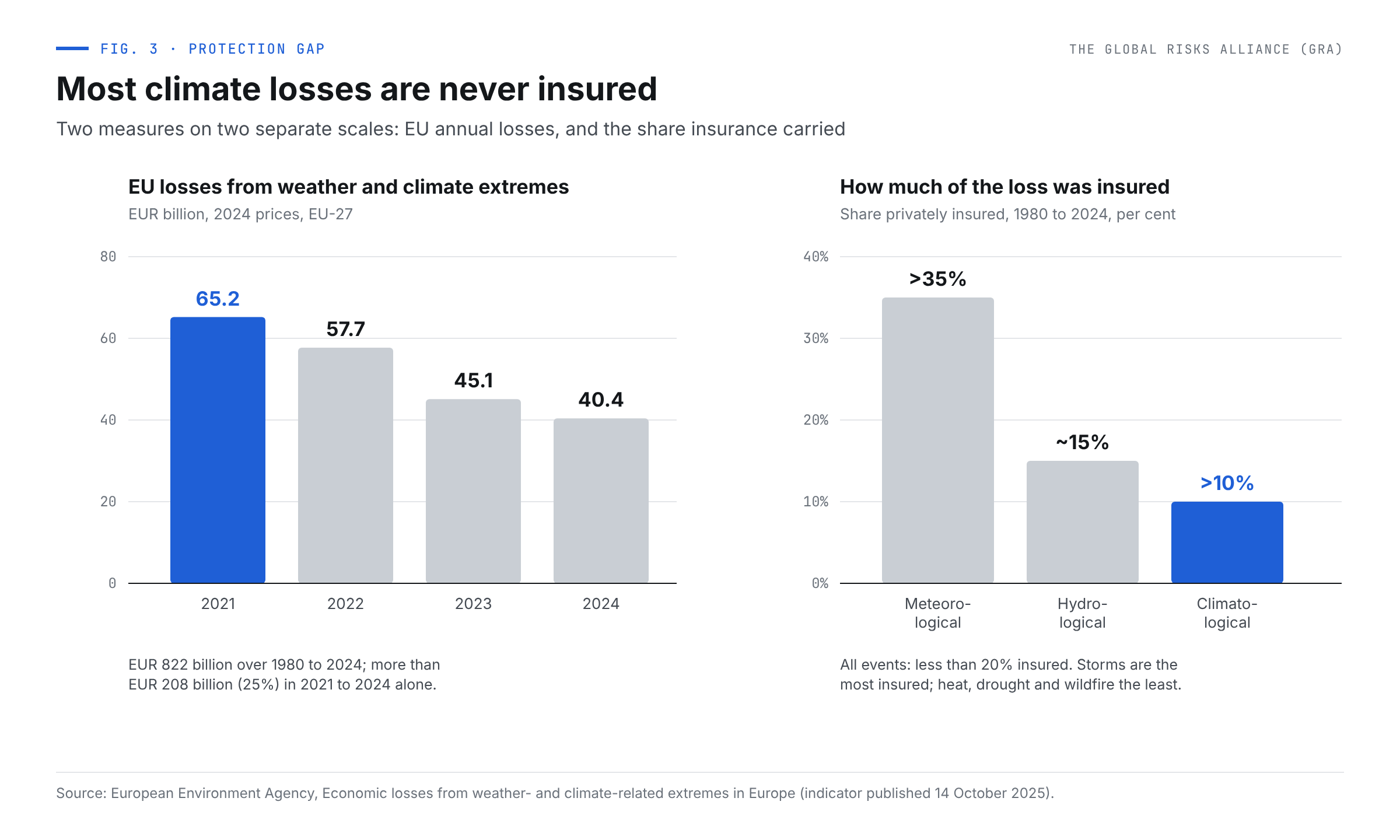
- The question the track reads is concrete: EU losses from weather and climate extremes reached EUR 822 billion over 1980 to 2024, and less than 20% of them were privately insured [4].
- Recognition is recorded, not awarded: a working-group contribution is credited, a learning completion is recorded only after verification, and no credential is issued until an accountable issuer, an assessment method and a revocation path are on record [5, 6].
- Simulation stays simulation: a simulated loss is never presented as an observed impact, and no exercise result is a loss forecast, a supervisory test or a capital requirement [1].
What the finance and insurance readiness track is
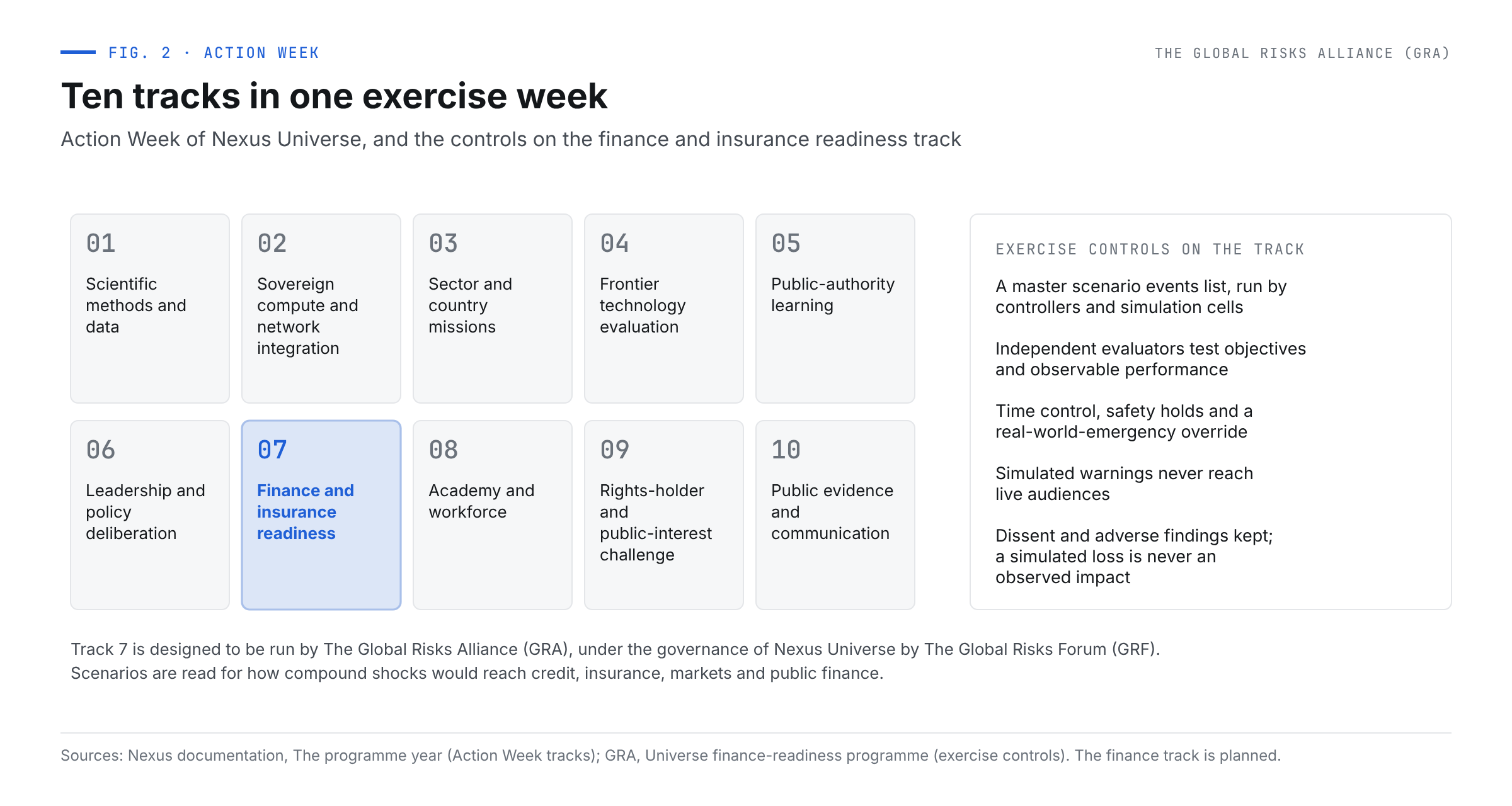
The finance and insurance readiness track is track 7 of the ten tracks of Action Week, the controlled exercise week of Nexus Universe, in which scenarios are read for how compound shocks would reach credit, insurance, markets and public finance [3, 1]. Nexus Universe is the annual operating, integration, exercise and learning programme of Nexus Consortiums, governed by GRF; GRA is designed to run the finance track under that governance, and the programme’s own site is universe.nexus [1].
The track is the visible moment of a year-long effort. Before it, candidate missions are read for financial transmission, protection gaps and diligence requirements, without selecting or recommending investments. During it, evaluators observe controlled scenario work. After it, results, failures, sensitivities and the dimensions not tested are recorded for review and correction [1]. This page follows that effort from the first quarter to the test and its reporting; its companion, from testing to reporting, correction and continuation, follows what happens next.
An earlier version of this page presented Nexus Universe as GRA’s own annual programme, with sector platforms, protocol labs, sponsors and recognition records organised around it. Nexus Universe is not a GRA event, and those structures are not on record in that form; the page now describes the programme year as the GRA home page and its pages on Nexus Universe set it out [1, 7].
Why finance needs a tested year, not an annual conference
Most of the loss from a severe event is never carried by insurance. The European Environment Agency estimates that weather and climate extremes caused EUR 822 billion of losses in the EU from 1980 to 2024, more than EUR 208 billion of it (25%) in the four years from 2021 to 2024 alone [4]. Less than 20% of the total was privately insured: over 35% for storms and other meteorological events, around 15% for floods and slightly over 10% for heatwaves, droughts, wildfires and cold spells [4]. The rest landed on households, firms and public budgets.
Supervisors have asked banks and insurers to treat that exposure as financial risk. The Basel Committee’s principles of 15 June 2022 set expectations for the management and supervision of climate-related financial risks, and IFRS S2, issued in June 2023 and effective for annual periods beginning on or after 1 January 2024, sets requirements for disclosing climate-related risks and opportunities [8, 9]. What institutions most often lack is the physical side: how a flood or a heatwave travels through power, water, transport and supply chains before it reaches a borrower or a policyholder.
A conference cannot supply that, because it does not test anything. A programme year can, if it builds its scenarios over months, tests them under control and records what failed. That is why the finance track is the last step of a year, and why its findings are published only after review.
The first quarter: questions and the mandate
The year opens with planning and gate G0, “annual programme authorised” [3]. National demand forms the agenda: each National Nexus programme sets its own agenda and agrees the scope of its profile before the first quarter, and national counterparts own the agenda, data and decisions [3]. The Foundry pillar opens the cycle projects and takes a baseline of every National Portfolio; Nexus Reports publishes the State and Agenda edition; and Risk Academy opens the year’s pathways and enrols cohorts tied to the missions [3].
GRA’s first-quarter work is agenda formation. Its readiness process is designed to identify the financial transmission, protection gaps and diligence requirements of candidate missions, without selecting or recommending investments [2]. On GRA’s Nexus cycle pages this is the question step: the financial sector brings the questions that no single institution can answer alone, such as which correlated exposures a flood basin creates across lenders and insurers.
The second quarter: readiness and the controlled build
Readiness preparation runs through the second quarter. Missions are admitted at G1, and data, people and resources are qualified at G2; the Foundry qualifies data sources and resource offers and builds the scenario models; and the Nexus Standards compose the mission profiles that apply [3]. The controlled build follows: one month to integrate software and data, sign builds and test security and interoperability, ending at G3 with the Core Build Report and a go or no-go decision for the exercise [3].
GRA’s readiness dialogues sit in this quarter. They ask what a mission would mean for finance before it is tested: which instruments could carry which losses, which data a lender or an insurer would need, and which safeguards would have to be in place [3, 10]. The answers are written as diligence questions with their evidence state, the form described on GRA’s finance and insurance readiness pages, so that the test can show where the evidence holds and where it does not [11].
The third quarter: the test week and the finance track
Action Week opens at G4, “controlled live operation authorised”, and runs ten tracks: scientific methods and data; sovereign compute and network integration; sector and country missions; frontier technology evaluation; public-authority learning; leadership and policy deliberation; finance and insurance readiness; Academy and workforce; rights-holder and public-interest challenge; and public evidence and communication [3].
The finance track runs under explicit exercise controls: a master scenario events list with controllers and simulation cells; independent evaluators who test objectives and observable performance rather than attendance; time control, safety holds and a real-world-emergency override; and a rule that simulated warnings never reach live audiences [1]. Its injects are financial events inside the scenario, read for how they would move through credit, insurance, markets and public finance. Competitors who take part do so under GRA’s written competition safeguards: no prices, terms, capacity or plans are discussed, and any data used is aggregated so that no firm can be identified [12].
Reporting what the test showed
The third quarter closes with the Stress Test and Readiness edition of Nexus Reports, after the evidence is sealed at G5 and the after-action review has recorded what worked, what failed and what was not tested [3]. GRA’s reading of the results is designed to inform the finance and insurance chapter of the annual flagship in the fourth quarter: protection gaps, fiscal and operational transmission, and diligence questions [2]. Until an edition is reviewed and released it is a candidate, and no edition has yet been released [13].
GRA’s own publications follow the same path to release: scope and sources recorded with their rights, findings written with one evidence label each, review by someone not responsible for the text, release with version, date, authors and funding source, and correction as recorded versions. A publication is evidence for the reader’s own judgement; it is never investment, credit, insurance or legal advice, a rating or a recommendation of any institution [14].
| Measure | Value | Scope |
|---|---|---|
| Losses, 2021 | EUR 65.2 billion [4] | EU-27, 2024 prices |
| Losses, 2022 | EUR 57.7 billion [4] | EU-27, 2024 prices |
| Losses, 2023 | EUR 45.1 billion [4] | EU-27, 2024 prices |
| Losses, 2024 | EUR 40.4 billion [4] | EU-27, 2024 prices |
| Insured share, meteorological events | Over 35% [4] | 1980 to 2024 |
| Insured share, hydrological events | Around 15% [4] | 1980 to 2024 |
| Insured share, climatological events | Slightly over 10% [4] | 1980 to 2024 |
| Insured share, all events | Less than 20% [4] | 1980 to 2024 |
Recognition: what is recorded, and what is never implied
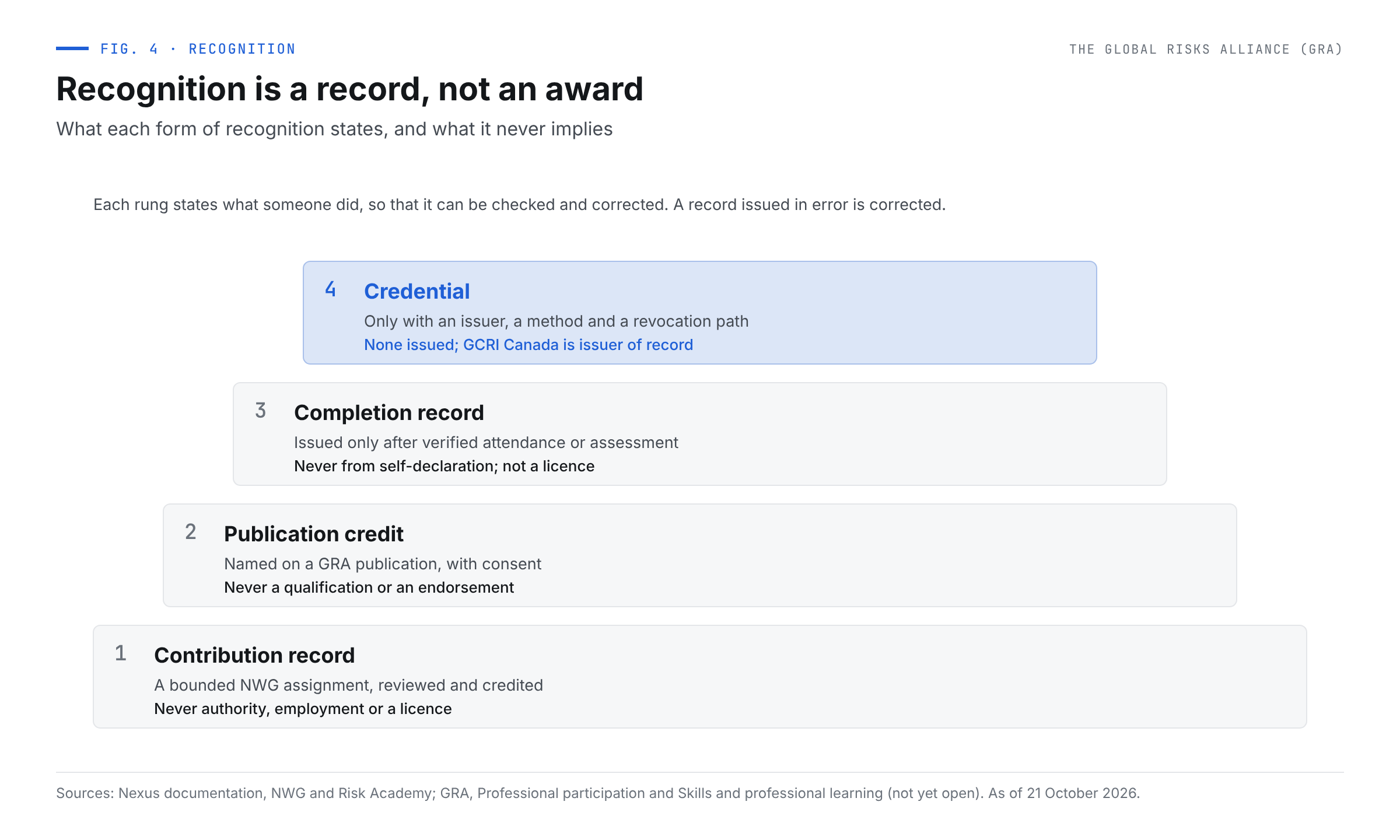
The earlier version of this page promised recognition records and badges for contribution during the year. In the current model recognition is a record of what someone did, kept so that it can be checked and corrected, and nothing more. In the National Working Groups, every bounded assignment ends with a contribution record and review, and then recognition and the next assignment [15]. In GRA’s work, contributors may be credited on publications with their consent, and a participant may state accurately what they contributed, but may not present it as a licence, a qualification or an endorsement [16].
Learning has its own rule. A GRA completion record is a verified statement that a person completed a named programme on a date; it is issued only after verification of attendance or assessment, never from self-declaration alone, and it can be corrected if issued in error. It is not a licence, a professional qualification or a certificate of competence [5]. Courses that GRA authors are hosted on Risk Academy, where completion is recorded and nothing is credentialed until an accountable issuer, an assessment method and a revocation path are on record; GCRI Canada is the issuer of record, and no credential has been issued [6].
How the track’s evidence is labelled
Every finding of the year carries one of nine evidence labels: observed, published statistics, institution-reported, estimated, modelled, forecast, scenario, expert judgement or unknown. Missing data is shown as missing, never as zero, and simulated results are never reported as observed impact [17]. The loss figures on this page are published statistics from the European Environment Agency; a loss produced in the finance track would be a scenario result, and would be labelled that way [4, 1].
The year’s records are kept in the programme’s shared evidence environment: participants, agreements and handoffs in NXS-RLS (participants, agreements and handoffs), and records and learning in NXS-HUB (knowledge, records and learning) [3]. Who took part in which capacity is kept in the programme’s participation records.
The frameworks the track prepares evidence for
The track does not take a role in any of these frameworks. It prepares evidence of the kind they ask institutions to hold, and supervisors may use published evidence like any other source; no participant gains privileged access [11].
| Year | Framework | Status and relevance |
|---|---|---|
| 2017 | WHO Simulation Exercise Manual | Current reference for designing, running and evaluating exercises [18] |
| 2022 | Basel Committee principles on climate-related financial risks | Published 15 June 2022 for banks and supervisors [8] |
| 2023 | IFRS S2 Climate-related Disclosures | Issued June 2023; effective for periods beginning on or after 1 January 2024 [9] |
| 2025 | EU Digital Operational Resilience Act (DORA) | In application since 17 January 2025 for 20 types of financial entities [19] |
What is changing
- The insured share stays low. Less than a fifth of EU climate losses since 1980 were insured, and the climatological share is lowest, which is where heat and drought scenarios matter most [4].
- Disclosure meets physical risk. IFRS S2 makes climate-related risks and opportunities a disclosure requirement, which raises demand for physical-risk evidence that can be traced to its source [9].
- Exercises over reports. Supervisors increasingly test response and recovery rather than read policies; the ECB’s 2024 cyber exercise covered 109 banks [20].
- Verified learning. Completion records that can be checked and corrected are replacing badges as the honest form of recognition [5].
Three institutions in one exercise week
The test week shows the three roles side by side. GRF governs the annual programme and records the gates, as set out in Nexus Universe at GRF and exercises and learning; national programmes bring their questions through national contributions. GCRI supplies evidence, methods and technical capability through its technical office, and GCRI Canada is the Consortium Secretariat. GRA reads the evidence for finance, insurance and development readiness and turns it into diligence material competent institutions can review [2, 1]. Lenders, insurers, investors and public authorities then decide independently, under their own authority; GRA’s role ends before that point [2].
Boundaries. What this page does not claim: the finance and insurance readiness track is planned, no programme year has yet run, and the programme is at service level R0. Nexus Universe is governed by GRF, not by GRA. GRA does not lend, underwrite, rate, invest, advise on or arrange transactions; readiness is not approval, and no exercise result is a loss forecast, a supervisory test, a capital requirement or a promise of funding or cover. A completion record is not a licence or a credential. GCRI does not regulate or certify, and GRF does not regulate, finance or procure.
Questions and answers
Is Nexus Universe a GRA event?
No. Nexus Universe is the annual programme of Nexus Consortiums, governed by GRF. GRA is designed to contribute the finance and insurance readiness track under that governance, with evidence and methods from GCRI.
Can a bank or insurer join the finance track now?
Not yet. Participation routes open only when their team, terms and review capacity are in place. Competitors who take part do so under GRA’s written competition safeguards, with aggregated data only.
Do exercise results lead to financing or cover?
No. Exercise findings are evidence with stated limits. GRA never lends, underwrites, invests or approves, and no result is a promise of funding, cover or capital.
Will I receive a certificate for taking part?
No certificate is issued. Contributions are credited and learning completions are recorded after verification; Risk Academy issues no credential until an issuer, an assessment method and a revocation path are on record.
Where will the track’s findings appear?
Reviewed findings are designed to inform the finance and insurance chapter of the annual Nexus Reports flagship, and GRA’s own professional briefs. No edition has yet been released.
Glossary
- Action Week: The one-week controlled exercise of Nexus Universe, opened at gate G4, with ten tracks.
- Inject: A scripted event introduced into an exercise scenario to test how participants respond.
- Protection gap: The share of economic loss from a hazard that is not insured or otherwise pre-financed.
- Readiness dialogue: A second-quarter discussion of what a mission would mean for finance, written as diligence questions.
- Completion record: A verified, correctable statement that a person completed a named programme on a date; not a licence.
- Evidence label: One of nine labels on every finding, from observed to unknown, so that a model is never read as a measurement.
Further reading across the network
- Universe finance-readiness programme
- GRA in the Consortium
- Scenarios and stress testing
- Protection gaps
- Skills and professional learning
- Annual operating cycle at GRF
- Annual programme cycle at GCRI
- The programme year in the Nexus documentation
References
- The Global Risks Alliance (2026). Universe finance-readiness programme. Accessed 2026-10-21.
- The Global Risks Alliance (2026). GRA in the Consortium. Accessed 2026-10-21.
- The Global Centre for Risk and Innovation (Nexus documentation) (2026). The programme year. Accessed 2026-10-21.
- European Environment Agency (2025). Economic losses from weather- and climate-related extremes in Europe. Accessed 2026-10-21.
- The Global Risks Alliance (2026). Skills and professional learning. Accessed 2026-10-21.
- The Global Centre for Risk and Innovation (Nexus documentation) (2026). Risk Academy (programme pillar). Accessed 2026-10-21.
- The Global Risks Alliance (2026). Claims and programme status. Accessed 2026-10-21.
- Basel Committee on Banking Supervision (2022). Principles for the effective management and supervision of climate-related financial risks. Accessed 2026-10-21.
- IFRS Foundation, International Sustainability Standards Board (2023). IFRS S2 Climate-related Disclosures. Accessed 2026-10-21.
- The Global Risks Alliance (2026). Finance and insurance readiness. Accessed 2026-10-21.
- The Global Centre for Risk and Innovation (Nexus documentation) (2026). Finance readiness. Accessed 2026-10-21.
- The Global Risks Alliance (2026). Competition safeguards. Accessed 2026-10-21.
- The Global Centre for Risk and Innovation (Nexus documentation) (2026). Nexus Reports (programme pillar). Accessed 2026-10-21.
- The Global Risks Alliance (2026). Publications and professional briefs. Accessed 2026-10-21.
- The Global Centre for Risk and Innovation (Nexus documentation) (2026). National Working Groups (NWG). Accessed 2026-10-21.
- The Global Risks Alliance (2026). Professional participation. Accessed 2026-10-21.
- The Global Centre for Risk and Innovation (Nexus documentation) (2026). Status and service levels. Accessed 2026-10-21.
- World Health Organization (2017). WHO Simulation Exercise Manual (WHO/WHE/CPI/2017.10). Accessed 2026-10-21.
- European Insurance and Occupational Pensions Authority (EIOPA) (2026). Digital Operational Resilience Act (DORA). Accessed 2026-10-21.
- European Central Bank (Banking Supervision) (2024). ECB concludes cyber resilience stress test. Accessed 2026-10-21.
Editorial record
Facts and programme states are given as of 21 October 2026. This page is reviewed at least every 180 days and whenever a programme state, a track or a cited figure changes. It replaces an earlier version that presented Nexus Universe as GRA’s own annual programme and promised recognition records and badges; those descriptions are not on the programme’s current record and are withdrawn here.
Published by the GRA editorial desk under the editorial integrity policy. To report an error or request a correction, use the corrections and updates route; corrections are dated and listed with the page. The current state of every GRA claim is on claims and programme status.